

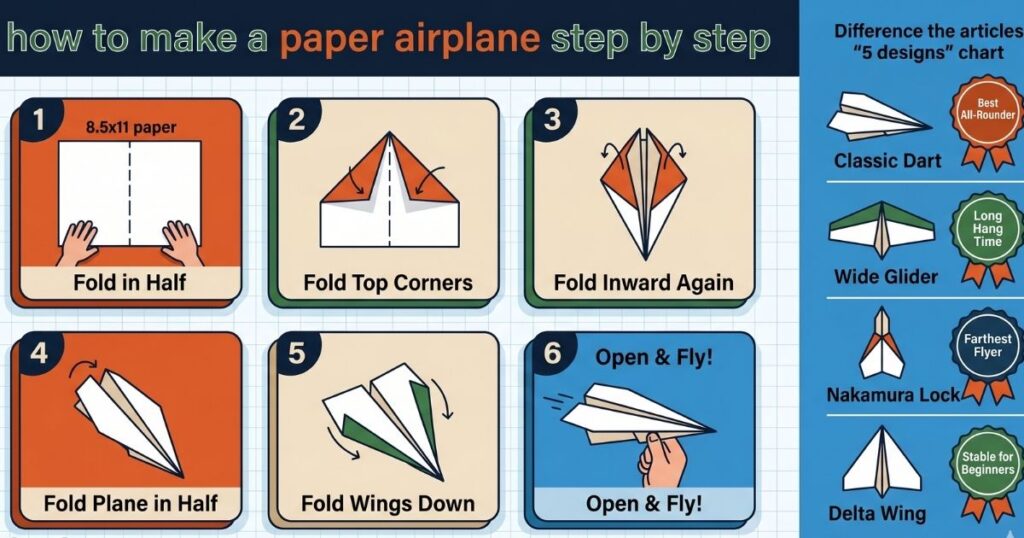
To make a paper airplane, fold an 8.5×11 sheet in half lengthwise, then fold both top corners to the center crease. Fold the slanted edges inward again, fold the whole plane in half, and fold each wing down evenly. Open the wings flat, hold the nose, and throw with a smooth, level motion. Total time: about 2–3 minutes.
What You Need to Get Started
The beauty of paper airplanes is that you need almost nothing. Here is what works best:
- Paper size: Standard US letter paper (8.5 × 11 inches). A4 paper (210 × 297 mm) also works perfectly — it produces a slightly sleeker dart.
- Paper weight: 20 lb (75 gsm) printer paper is ideal. Heavier paper gives sharper folds but reduces airtime; lighter paper drifts unpredictably.
- Surface: A flat table or desk makes crisp creases much easier.
- Optional — ruler: Running a ruler along your fold lines sharpens creases and improves symmetry, which directly improves flight stability.
Pro tip: Avoid glossy or coated paper. The surface resists folding cleanly, and the plane will not hold its shape during flight.
How to Make the Classic Dart Paper Airplane (Step by Step)
The classic dart is the most popular paper airplane in the world for good reason: it is fast, accurate, and easy to master. Follow these six steps exactly.
Fold the paper in half lengthwise (hot-dog fold)
Place the sheet flat, portrait orientation (tall, not wide). Fold it in half from left to right, aligning the edges precisely. Press the crease firmly with your fingernail from top to bottom. Then unfold it back flat — this center line is your guide crease for every step that follows.
Fold the top two corners to the center line
Working from the top of the sheet, fold the top-left corner diagonally inward so its edge meets the center crease exactly. Do the same on the right side. The result is a symmetrical triangle at the top of the page. Make sure both corners meet the crease at the same point — symmetry here is critical for straight flight.
Fold the diagonal edges inward to the center line again
You should now see two slanted edges running from the top-center down toward the sides. Fold each of those slanted edges inward to the center crease again. This creates a sharper, more pointed nose — the hallmark of the classic dart. Press those creases flat.
Fold the whole plane in half along the center crease
Fold the entire plane along the original center crease, so the right half sits perfectly on top of the left half. The pointed nose and all the layers should align cleanly. If they do not, gently unfold and re-press any uneven folds from Step 2 and 3.
Fold each wing down
With the plane folded in half, fold the top layer (one wing) downward so the top edge aligns with the bottom edge of the fuselage (body). The crease of this fold should run parallel to the bottom edge. Flip the plane over and fold the second wing down in exactly the same way. Equal wings = equal lift.
Open the wings and fine-tune before you throw
Hold the fuselage and spread both wings until they form a flat, straight line or a very slight upward angle (called a dihedral). Hold the plane underneath the nose area, not the middle. Throw smoothly and straight forward — not upward. If the plane dives, slightly bend the trailing edges of both wings upward about 2–3 mm to add lift.
How long does it take? With practice, you can complete this in 90 seconds. Your first attempt may take 3–5 minutes — that is perfectly normal.
5 Best Paper Airplane Designs Compared
Different designs serve different goals. Here is how the five most popular styles compare:
Classic Dart
Best all-rounder. Fast, accurate, good distance. Great for beginners.Most Popular
Wide Glider
Wide wings for slow, floaty flight. Best for long hang time indoors.Intermediate
Nakamura Lock
Japanese design with tucked nose. Flies far and straight without diving.Intermediate
Delta Wing
Triangular plan form. Extremely stable, handles well in light winds.Beginner
Stunt Looper
Short, stubby wings with upward flaps for loops and stunts.Advanced
Which design is best for distance?
If your goal is maximum distance, the Nakamura Lock and the Wide Glider outperform the dart outdoors because their larger wing area generates more lift relative to drag. Indoors with no wind, the dart wins on pure velocity. For kids learning for the first time, the Classic Dart is still the best starting point because forgiveness in the throw angle is higher.
Advanced Design: How to Make a Wide Glider
Once you have mastered the dart, the Wide Glider is the natural next step. It uses the same materials but achieves longer hang time, which makes it satisfying for gentle indoor flights or demonstrations.
Start landscape (hamburger fold)
Place the paper horizontally (wider than tall). Fold in half top to bottom. Crease and keep folded.
Create the nose triangle on the folded edge
Fold the left-side top corner down to meet the bottom edge. The result is a right-triangle shape on the left side.
Fold both layers together
Fold the entire right portion of the sheet back over to the left along the right edge of the triangle you just created. This locks the nose shape in place.
Add a small elevator flap on each wing
Fold both wing trailing edges (the back edge) upward about 5 mm. This creates the lift curve that makes the glider float rather than dart forward.
Throw gently forward and level
The Wide Glider does not like speed. A gentle, level push — almost like placing it into the air — produces the best glide. Aim straight ahead, not upward.
Pro Flying Tips to Maximize Distance and Accuracy
Throwing technique matters as much as folding
You can fold the most perfect dart in the world and still make it crash with a bad throw. Here is what the best paper airplane throwers do consistently:
- Hold the plane between your thumb and index finger just behind the nose — about one-quarter of the way back from the tip.
- Throw smoothly and at a slight upward angle (roughly 10–15 degrees above horizontal for maximum distance).
- Release the plane with your wrist, not just your arm — a snap of the wrist at the end of the throw adds speed without sacrificing control.
- Keep your arm relaxed, not tense. Tense throws tend to add unwanted spin that destabilizes the plane.
How to adjust a paper airplane that keeps crashing
- Plane dives immediately: Bend the trailing edges of both wings up slightly (2–3 mm). This adds lift at the back.
- Plane climbs steeply then stalls: Bend the trailing edges down slightly, or reduce your throw angle.
- Plane veers left or right: One wing is higher than the other. Adjust by slightly bending the rudder (the back vertical surface of the fuselage, if present) the opposite direction, or re-fold for better symmetry.
- Plane wobbles end-to-end: The nose is too light. Add a small paper clip to the nose to shift the center of gravity forward.
Science fact: A paper airplane with its center of gravity ahead of its center of lift will fly stably. Move the CG too far back and it becomes unstable. This is the same principle that governs real aircraft design.
Common Mistakes and How to Fix Them
Uneven fold lines
The single biggest cause of bad flights is asymmetry. If the left wing is wider than the right, the plane will curve. Take your time lining up corners and edges before you press any crease. Using a ruler on a flat surface helps enormously, especially with younger children.
Pressing creases with your fingertip instead of your nail
A sharp crease holds its shape. A soft crease relaxes and the wing sags. Run the flat edge of your fingernail — or the spine of a pen — along every fold line until you feel and see a crisp, hard edge.
Throwing too hard
Counterintuitively, a harder throw often makes a paper airplane fly shorter and less straight. Most paper airplanes are not designed to handle the aerodynamic forces of a very fast throw. A firm, controlled, smooth throw almost always beats a hard one.
Skipping the wing-angle check
Before every throw, make sure both wings are at the same angle and are not bowed or curled. Small bends in the paper accumulate through handling and a quick visual check — looking at the plane head-on, from the front — takes only two seconds.
For parents and teachers: Paper airplane activity is categorized as a fine motor skill builder by occupational therapists. Encourage children to refold rather than re-throw a crashing plane — the problem-solving process is the learning.
Paper Airplane World Records
Paper airplane competition is a real sport, and the records are remarkable:
- Farthest flight distance: 226 feet 10 inches (69.14 meters) — set by Joe Ayoob using a plane designed by John Collins (“The Paper Airplane Guy”) in February 2012. This record still stands as of 2026.
- Longest airtime: 29.2 seconds — set by Takuo Toda of Japan in 2009 using a small hand-folded plane in a gymnasium.
- Largest paper airplane to fly: A 45-foot wingspan plane was launched in Arizona in 2022, though it glided rather than flew freely.
John Collins’s distance record design (named “Suzanne”) uses a wide, flat delta-wing shape with a very specific weight distribution. Collins has published the full instructions — it is a challenging but rewarding fold for serious enthusiasts.
People Also Ask
What is the easiest paper airplane to make for beginners?
The Classic Dart (sometimes called the Basic Dart) is the easiest paper airplane to make. It requires only six folds, no cuts or tape, and is ready to fly in under three minutes. The Delta Wing is also excellent for very young children because it has fewer folds and is more forgiving of imprecise creasing.
How do you make a paper airplane fly farther?
To make a paper airplane fly farther: (1) use crisp, symmetrical folds; (2) throw at a 10–15 degree upward angle with a smooth, firm motion; (3) add tiny upward bends to the trailing wing edges for extra lift; and (4) add a small paper clip to the nose to fine-tune the center of gravity. Wind conditions matter too — throwing with a light tailwind outdoors can add 30–40% to your distance.
Does paper airplane size affect how far it flies?
Yes, but not in the way most people expect. Larger planes are not automatically farther-flying — their extra weight requires more throw force and they are more sensitive to asymmetry. Smaller planes are easier to fold precisely and can achieve excellent distance-to-size ratios. The world record distance plane was roughly standard letter-paper size, not unusually large.
Can I make a paper airplane without any tape or scissors?
Yes — all the designs in this guide require only a single sheet of paper and your hands. No tape, scissors, or glue is needed. Some competitive or display designs do use small pieces of tape to reinforce the nose or lock wing angles, but for everyday flying, tape-free folds work just as well and are easier to adjust.
What angle should you throw a paper airplane at?
For maximum distance, throw at approximately 10–15 degrees above horizontal. Throwing straight horizontal usually causes the plane to lose altitude too quickly before generating lift. Throwing too steeply (above 30 degrees) causes the plane to stall at the peak of its arc and nose-dive back down. A 10–15 degree angle gives enough upward momentum for the wings to take over smoothly.
What is the science behind why paper airplanes fly?
Paper airplanes fly using the same four forces as real aircraft: lift, drag, thrust, and gravity. The wings generate lift because they are angled slightly upward (angle of attack), which forces air downward and — by Newton’s third law — pushes the wing up. Drag slows the plane forward. Your throw provides initial thrust. The plane flies until drag and gravity overcome the remaining momentum and lift. The shape and weight distribution determine how long that balance holds.
What type of paper is best for making a paper airplane?
Standard 20 lb (75 gsm) printer paper is the best choice for most paper airplane designs. It holds creases well, is light enough to glide efficiently, and is widely available. Construction paper is too heavy for gliding designs. Newspaper is too soft and limp. For competition-level planes, some folders use 24 lb (90 gsm) paper for sharper creases on complex folds.
How do you make a paper airplane fly straight?
The three most important factors for straight flight are: (1) symmetrical folds — both wings must be identical; (2) a level throw — releasing the plane with both wings at exactly the same height; and (3) wing washout — if the plane still curves after checking symmetry, try bending the trailing edge of the wing it curves toward very slightly downward, which increases drag on that side and corrects the turn.
Is there a paper airplane that can do loops?
Yes. The Stunt Looper design is specifically built for loops. It has short, wide wings and strong upward elevator flaps on the trailing edges. You throw it hard and slightly upward, and the upward elevator forces the nose up continuously until the plane completes a loop. You can also coax a standard dart into a gentle loop by bending its trailing edges up significantly and throwing with firm upward force — though this is less reliable than a purpose-built stunt design.
Are paper airplanes good for STEM education?
Absolutely. Paper airplanes are one of the most effective entry-level STEM tools available. They teach aerodynamics (lift, drag, thrust, gravity), physics (center of mass vs. center of lift), engineering design iteration (adjust, test, adjust again), geometry (angles, symmetry), and fine motor skills. The Red Bull Paper Wings competition and NASA have both used paper airplane activities in formal STEM education curricula.
How do I make a paper airplane with a longer hang time?
Longer hang time (airtime) requires a high lift-to-drag ratio. Use a wide-wing glider design rather than a narrow dart. Add small upward elevator flaps to the trailing wings. Throw gently and level — not hard. Fly indoors where there is no turbulence. The current world record for hang time is 29.2 seconds, achieved indoors in a controlled environment with a small, precision-folded design.
Sources & References
- Guinness World Records — Farthest flight by a paper aircraft (2012)
- John Collins, “The Paper Airplane Guy” — thepaperairplaneguy.com — Original designer of the world-record “Suzanne” fold
- NASA Glenn Research Center — Aeronautics for Students: Forces on a Glider — grc.nasa.gov
- Red Bull Paper Wings — Official international paper airplane competition — redbull.com/paper-wings
- American Institute of Aeronautics and Astronautics (AIAA) — Educational resources on lift and drag

“I’m Erin, a crafting expert dedicated to making art accessible and fun for everyone. From jumping origami frogs to beautiful paper flowers, I love designing easy, engaging craft tutorials that spark creativity and bring families together.”
